
This is how to make AI push back on you
By default, AI is agreeable. That’s pleasant and useless. Skill four: turning the yes-machine into an honest second opinion.
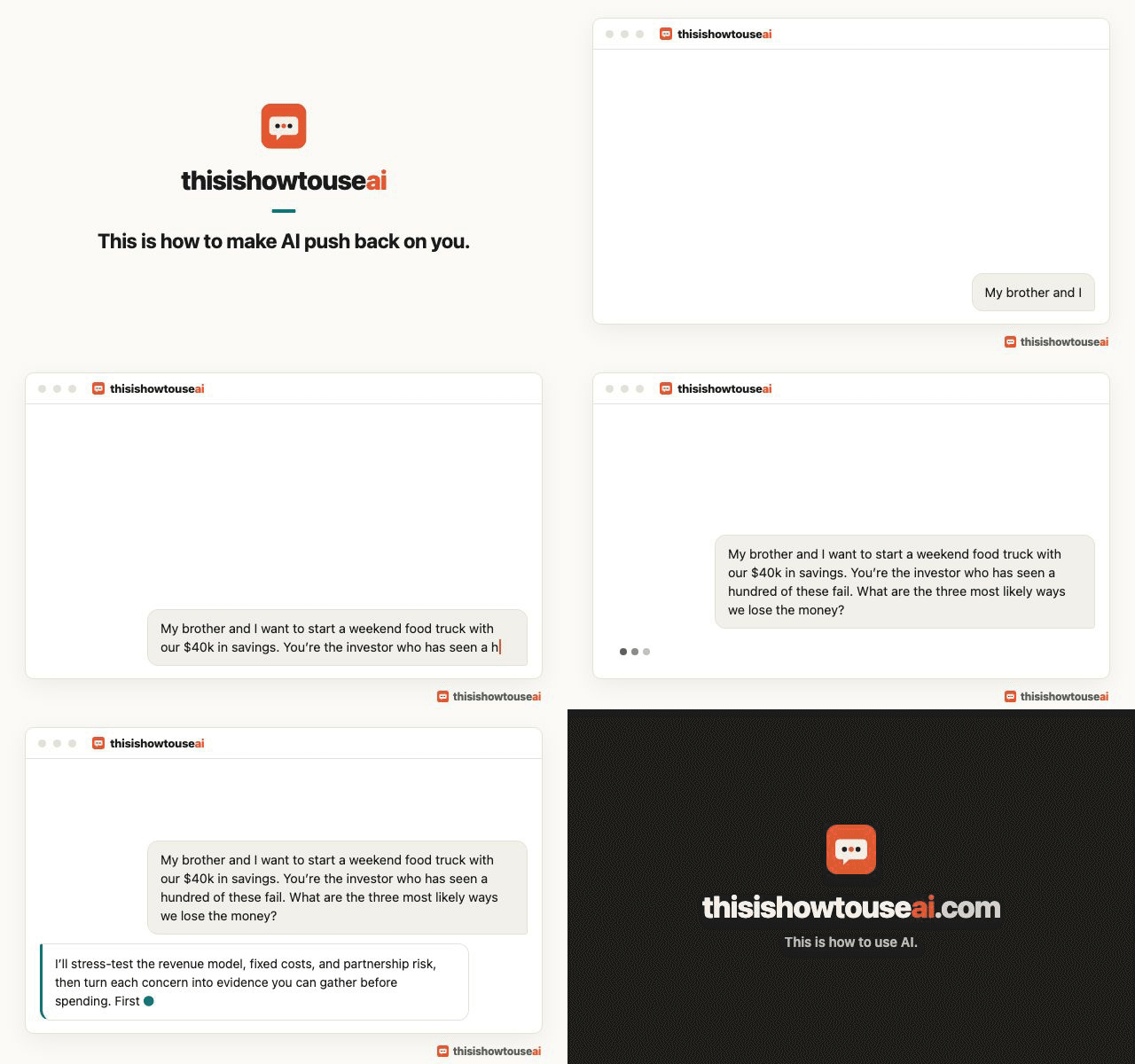
This is how to make AI push back on you.
Here’s the default behavior nobody warns you about: ask an AI what it thinks of your idea, and it will find something nice to say. Your business plan is "promising." Your email is "clear and professional." Your reasoning "makes a lot of sense." It is agreeable by disposition, and agreeable is useless when you’re about to spend money.
The fix isn’t hoping for honesty. It’s making agreement structurally impossible.
Watch it happen
The ask that invites flattery:
I’m thinking about starting a weekend food truck with my brother. $40k saved between us. Good idea?
The pat on the head:
That sounds like an exciting venture! Food trucks have lower overhead than restaurants, and partnering with family can be rewarding. With $40k you have a reasonable starting budget. Key steps would be...
Now the same question, restructured so "it’s great!" is not an available answer:
The restructured ask:
Same idea, but: you are the investor I’m pitching, you’ve seen a hundred of these fail, and your job is to find the reasons this one does. Give me the three most likely ways we lose the $40k, which one is most probable for US specifically (first-timers, weekends only, brother partnership), and the one question we can’t answer that should stop us.
A useful answer to that version should examine weekend-only revenue, fixed commissary and permit costs, and the strain a business can put on a family relationship. Those are hypotheses to investigate before a deposit, not reasons to trust the chatbot as an investor, regulator, or family counselor.
The four pushback structures
- Assign the adversary role. "You are the investor / the opposing lawyer / the health inspector." Roles carry standards; standards produce objections.
- Demand the failure case. "Give me the three most likely ways this fails" cannot be answered with encouragement.
- Force a ranking. "Which of these worries applies most to MY situation" turns generic caution into specific caution.
- Ask for the stopper. "What’s the one question that should stop us if we can’t answer it." This is the highest-value sentence in the set.
The failure mode of the failure mode
Push hard enough and you get the opposite problem: performative doom. Ask "why will this fail" about anything and it will oblige, including about ideas that are actually fine. The calibration move is asking both directions: "steelman this, then break it, then tell me which argument you find more convincing and why." You want its reasoning, not its posture, in either direction.
And remember what it is: pattern, not judgment. Its pushback is a well-read friend’s, not an underwriter’s. For decisions with real money or legal weight, turn every objection into something checkable: current permit requirements from the local authority, actual commissary quotes, a written budget, and a real agreement between the people involved.
The habit
Any time you notice you WANT the AI to say yes, that’s the moment to use these. The want is the tell.
- Share only: The idea, rounded budget, assumptions, and non-confidential constraints; the pushback does not need account records, private communications, or identifying details.
- Verify: Every objection using current permits, written quotes, a real budget, contracts, local authorities, and the accountable people who would carry the risk.
This is how to use AI.